Every era of software had a stack.
The early web had LAMP - a bunch of letters you'd learn once and then use to build basically everything. The Ruby years had Rails + Heroku, which made deploying feel like hitting send on a text message. React + Firebase ran the early 2010s. Next.js + Vercel ran the Jamstack years. Supabase showed up and taught a whole generation that you could have a real database without hiring a database person.
Look at those for a second and something pops out: each one won because it made one specific kind of pain go away.
Servers used to need a sysadmin. LAMP made that pain go away. Deployments used to take a weekend. Heroku made that pain go away. You used to need a backend engineer to have a real database. Supabase made that pain go away.
Every era has its pain. Every winning combo is the one that kills the pain.
Which brings us to now.
The pain of this era
You've felt it. You open Claude Code. You type what you want. Claude writes beautiful code. Then, every ten minutes or so, Claude says something like:
"Now open your Supabase dashboard, go to the SQL editor, paste this migration, and let me know if there are any errors."
You sigh. You open a new tab. You find the dashboard. You paste the thing. Something breaks. You copy the error back into chat. Claude rewrites. You paste again. An hour ago you were vibing on a product idea. Now you're doing database administration, a sentence you never wanted to say.
This is the pain. The AI is doing the thinking. You are doing the typing, the pasting, the clicking, the fixing. You are the middleman between a very smart assistant and your actual stack, and you are a slow middleman. Every previous stack in history made this job easier. None of them removed you from it. You were always on the clock.
Here's the thing about this era's winning combo: it's the first one that lets you put down the clock.
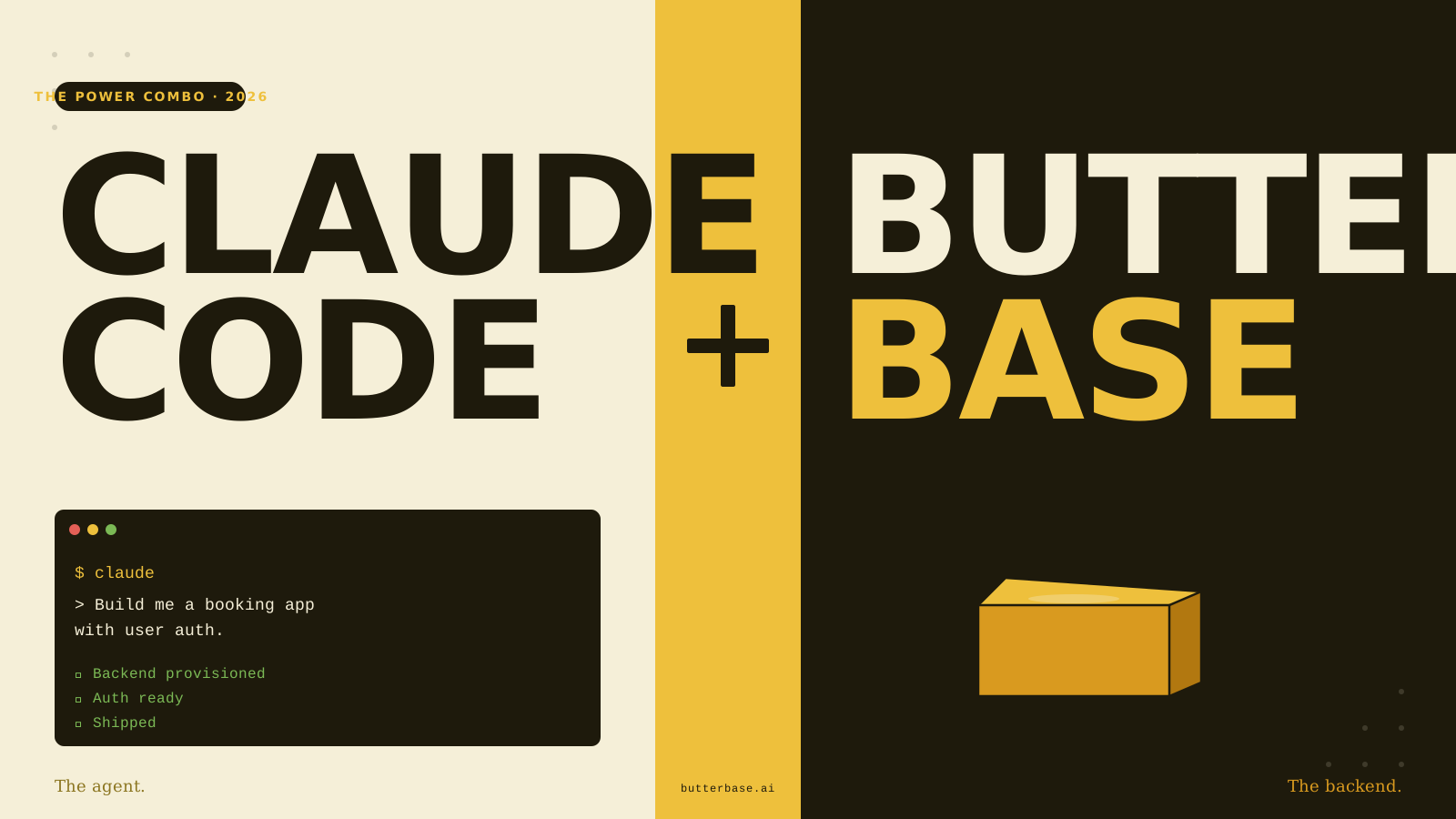
Claude Code + Butterbase
That's it. That's the combo.
When Claude Code talks to Butterbase, it doesn't ask you to paste migrations. It just makes the tables. It doesn't tell you to click through six settings pages to set up Google sign-in. It just sets it up. It doesn't hand you a list of environment variables to configure on some other site. It configures them and moves on.
You stop being the one doing the work. You become the one describing the work.
That's the only thing that matters. Everything else flows from it. If you've vibe coded enough to feel the frustration of being Claude's copy-paste assistant, you already understand why this combo wins. And if you haven't - the first time you try it, you will.
What it feels like
It's a Saturday morning. You have an idea: a little app where people can book your time for freelance design work. Calendar, payments, a simple profile page.
You open Claude Code. You type it out. Claude thinks for a second, and then starts doing things. Your database gets tables - users, bookings, services. Google sign-in works. Stripe is wired up. Your calendar is synced. Your page goes live on a real URL that you can send to a friend. The whole thing takes the length of a conversation.
At no point did you open a second tab. At no point did you paste SQL. At no point did you google "how to configure CORS for production" or stare at an error message wondering what a foreign key constraint is. You described. Claude built. You tested. You shipped.
That's the feeling. It's the feeling Heroku people had the first time they deployed a Rails app. The feeling Vercel people had the first time git push put something on the internet. A specific flavor of oh, it's supposed to work like this.
Every good stack era gives you that feeling once. This era gives you that feeling a lot, because there are so many more moments where the old way was secretly painful and the new way just isn't. Schema changes. Auth setup. Deployment. Storage. Real-time. Each of those used to be a mini-project. Now they're just prompts.
The five walls
Most vibe coders have a graveyard of projects that "almost" made it. Not because the idea was bad - because somewhere between idea and live URL, there was a wall the AI couldn't get past. You needed to step in. You got tired. The project died in your drafts.
Those walls are extremely predictable. There are basically five.
Wall one: the schema change. Claude writes SQL. You're supposed to paste it somewhere. You don't totally know where. Something breaks. You lose an hour. With Butterbase, Claude just makes the change. No paste. No error to decode.
Wall two: auth setup. Sign-up, password reset, Google login, email verification. Every piece is its own config page on most backends. On Butterbase, it's a couple of prompts.
Wall three: "only-me" data rules. This is the one that kills most side projects silently. When your friends test your app, everyone can see everyone else's data. Fixing it requires writing something called "row-level security policies," which sounds - and is - a lot for a weekend project. On Butterbase, Claude handles it with one tool call. Your data is private by default.
Wall four: secrets. Stripe keys. Email service keys. Claude writes a function that needs them. On most stacks, you paste them into a dashboard. On Butterbase, Claude just sets them.
Wall five: shipping. Claude has built your app. Now it's supposed to live on the internet. On most stacks, you go set up Vercel or Netlify, connect repos, configure build commands. On Butterbase, Claude puts it live. Real HTTPS URL. Done.
Each of these is a small moment. Together they're the difference between "I shipped" and "I meant to finish that project but then life happened."
Why this combo and not Claude Code + anything else
Claude Code works with other backends. You can point it at Supabase. You can tell it to generate migrations for Firebase. It'll work in the technical sense. It just won't feel the same.
The difference isn't that other backends are bad. Most are really good. They were just built for a different kind of person - a developer who wanted to be the one doing the configuring, with a nice interface for doing it. They never imagined a world where the AI was trying to do the configuring itself. So every time the AI reaches for something, it has to hand off to you. Every handoff is a moment the vibe dies.
Butterbase was built from the first line of code assuming the AI would be the one driving. The whole platform is designed to be operated by Claude, not by you. You get to watch. Which is a weird thing to get used to at first, and then very quickly you don't want to go back.
It's a little like the first time you rode in a car that drives itself. Or the first time someone made your coffee exactly how you like it without asking. There's this moment where you reach for the wheel - or the sugar - and then realize you don't have to. And you also realize that every previous version required you to reach for the wheel, and you just hadn't noticed it was work.
Who's on this
Early adopters of any stack tell you where it's going. Rails was shipped by startup founders. Next.js was shipped by frontend devs. Supabase was shipped by indie hackers.
Claude Code + Butterbase is getting picked up by three groups, fast.
Solo builders shipping real SaaS on weekends. People who would've spent last year wrestling with Supabase and Stripe are now shipping the same thing on Saturday afternoon. The people who always "had an idea for a SaaS" are now just building it.
Non-developer founders with ideas and a little bit of money. Used to be, the first version of a software company cost twenty grand and took four months. Now it costs the price of a Claude subscription and takes a weekend. That's a genuinely new thing.
Small teams who realized their fastest builder is the AI. A two-person team shipping what used to take ten. The whole shape of what a "small company" can do is changing.
None of these groups are being marketed to. They just figured out the combo works, and they're quietly shipping. That's always how a stack actually wins. Not because people are told about it - because the people who build the most start using it, and the rest of the world catches up.
What comes next
If you squint, you can see where this is heading.
Every piece of your stack that still requires you to click buttons will, over the next year or two, get an agent-native version. Deployment. Monitoring. Email. Payments. Analytics. The whole toolkit is going to get rebuilt for a world where the AI is the one using it, not the human.
The kind of person who starts a company will keep changing. Less engineer, more everything-else. An idea plus an AI plus a good stack is all you'll need. That has always been the promise of software, and it's finally starting to be the actual experience.
But that's later. For right now, in 2026, if you're vibe coding and you want to feel what the full version of this feels like, there's one stack where it's already landed.
Getting in
Takes a minute.
- Grab an API key from butterbase.ai.
- Paste these into your terminal:
claude plugin marketplace add https://github.com/NetGPT-Inc/butterbase-plugin
claude plugin install butterbase
export BUTTERBASE_API_KEY=bb_sk_your_key_here- Open Claude Code and describe what you want to build.
That's it. You're set.
If you're on Cursor, Windsurf, Zed, or another MCP-capable tool, the docs have a two-line config you can paste into your editor's MCP settings. Same 43 tools, same combo, same result.
One last thing
Stacks are funny. For years, the people shipping the most are quiet about the stack they're using, because it feels like cheating. They ship in half the time and everyone else assumes they just work harder. Then one day the stack becomes obvious, and for a few years everyone uses it, and the tempo of what's possible shifts.
We're in the quiet part right now. The people who have the combo are shipping fast and not saying much. You're reading this in the quiet part, which means you get to move before the combo becomes obvious.
Claude Code + Butterbase. If you know, you know. If you don't, now you do.
Frequently asked questions
It's the combination of Anthropic's Claude Code (an AI coding agent that runs in your terminal) and Butterbase (an MCP-native backend for Postgres, auth, storage, functions, hosting and realtime). Claude Code drives the backend directly via MCP, so you describe what you want and the AI provisions tables, auth, storage, secrets, edge functions, and deployment without you opening a dashboard.
Supabase was designed for human developers using a dashboard, so when Claude needs to make a schema change, set a secret, or configure auth, it has to hand off to you to copy-paste SQL or click through settings. Butterbase was built from day one assuming the AI is the operator, so Claude executes those steps directly via MCP tool calls. Same primitives - Postgres, auth, storage, functions - different operator.
No. You describe what you want in plain English ("users can book a time slot and pay") and Claude Code generates the schema, RLS policies, and API logic, then executes them on Butterbase via MCP. You can read the SQL Claude writes if you want to learn, but you never have to write or paste it yourself.
Anything that supports the Model Context Protocol (MCP). That includes Claude Code, Cursor, Windsurf, Zed, and a growing list of MCP-capable editors. The setup is a single config block - see docs.butterbase.ai/getting-started/mcp-setup for the exact snippet.
A managed Postgres database, user authentication (email + Google by default), file storage, realtime subscriptions, edge functions, hosting with a real HTTPS URL, secret management, and 43 MCP tools that let your AI coding agent operate all of it without leaving the chat.
No. Solo builders are early adopters because the productivity jump is most visible there, but small teams shipping production SaaS are the fastest-growing group on the stack. Butterbase scales on managed Postgres, so the same project that starts on a Saturday can run a real customer base later.
Grab an API key from butterbase.ai, install the Claude Code plugin (claude plugin marketplace add https://github.com/NetGPT-Inc/butterbase-plugin then claude plugin install butterbase), export BUTTERBASE_API_KEY, then open Claude Code and describe your app. For Cursor, Windsurf or Zed, paste the MCP config from the docs instead.