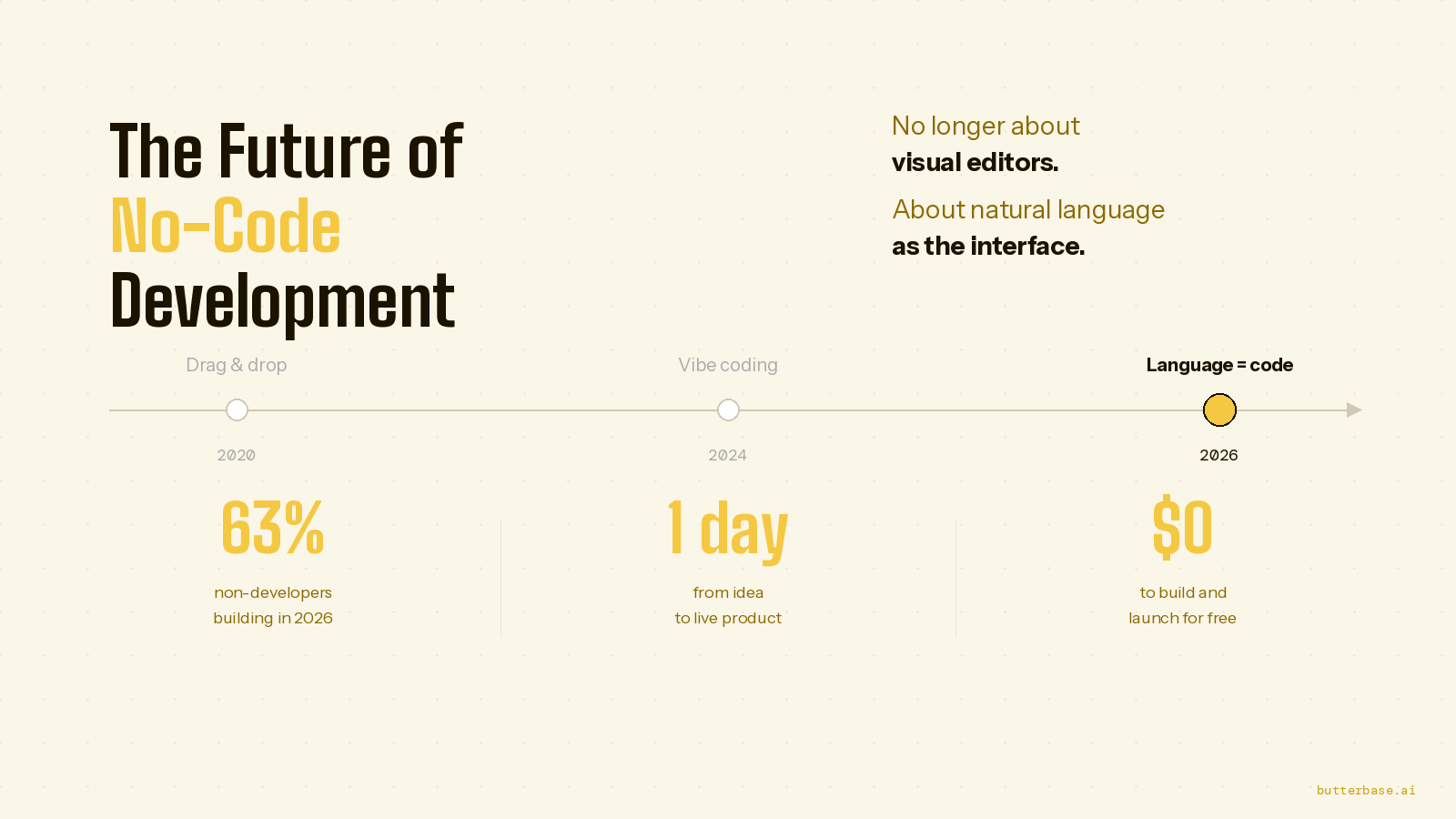
No-code is not what it was two years ago. And in two more years, it will look nothing like it does today.
The tools that defined no-code from 2018 to 2023 - drag-and-drop builders, visual workflow editors, template-based platforms - were genuinely useful but had a clear ceiling. You could build a website. You could automate a simple workflow. You could create a form that saved data to a spreadsheet. But the moment you needed something real - a product with user accounts, a database that handled complex relationships, a backend that processed payments and sent notifications - you hit a wall.
That wall is coming down. Not gradually. In large sections, all at once.
Understanding what is driving this change, what it means for the people building products today, and where no-code development is heading over the next two years is one of the most practically useful things a founder or builder can do right now. The decisions you make about how to build in 2026 will compound - the builders who understand the direction of the tools will move faster, ship better products, and find themselves ahead of competitors who are still thinking about development the way it worked in 2022.
Why everything changed at once
Three things converged between 2024 and 2026, and their combination produced something that none of them would have created alone.
The models got genuinely good at code.
In 2023, AI coding assistants were impressive but unreliable. They generated plausible-looking code that broke in unpredictable ways. The debugging loop was often longer than writing the code manually would have been. By 2025, the major models - Claude, GPT-4o, Gemini - had made leaps in code quality that changed the practical experience of building with them. Code that once required significant correction now works on the first attempt more often than not. The models understand context, catch their own errors, and maintain consistency across large codebases in ways that were not possible two years earlier.
The infrastructure became AI-native.
The first wave of AI coding tools helped you write code. But the code still ran on infrastructure designed for humans - databases you had to configure through dashboards, authentication systems you had to set up manually, APIs you had to design and document yourself. The second wave solved this. Model Context Protocol (MCP), an open standard released by Anthropic in late 2024, created a way for AI tools to communicate directly with external services. A backend like Butterbase that connects via MCP can provision a database, configure authentication, set up file storage, and generate API endpoints automatically from the same natural language prompt where you describe the product. The AI tool and the infrastructure are speaking the same language.
Non-technical people discovered they could build.
This was not obvious until it happened. The assumption in the developer community was that AI coding tools would primarily make developers faster. What actually happened is that a large population of non-technical people - product managers, founders, marketers, teachers, small business owners - discovered that they could build real software by describing what they wanted. The 63% of vibe coding users who identify as non-developers in 2026 surveys is not a small footnote. It is a structural shift in who is building software and why.
What no-code actually means in 2026
The term has splintered into three distinct things, and conflating them leads to bad decisions.
Traditional no-code - Visual editors, drag and drop, proprietary platforms. Webflow for websites. Bubble for complex web apps. Glide for data-driven mobile apps. Softr for client portals on top of Airtable. These tools are mature, well-documented, and genuinely excellent for specific use cases. They have not been replaced. They have gotten better, and AI has been added to all of them. The ceiling has risen but it still exists - there are things these platforms cannot do, and migrating away from them is non-trivial.
Vibe coding - Building with AI coding tools by describing what you want in natural language. Claude Code, Cursor, Windsurf, Bolt. You never write code, but the output is code - real, deployable, maintainable software. Not a visual builder's proprietary format, not a template, but actual code running on actual infrastructure. The constraint is not the tools; it is the clarity with which you can describe what you need and the speed with which you can evaluate and iterate on what you get.
AI-native platforms - New infrastructure built specifically for AI-first building. Backends like Butterbase that connect to AI tools via MCP and provision automatically. Deployment platforms that receive instructions from AI agents. Authentication services that configure themselves from natural language descriptions of what the product needs. This category barely existed in 2024. In 2026 it is the fastest-growing part of the builder landscape.
The practical implication: choosing between these approaches is one of the most important decisions a builder makes. Getting it wrong means spending weeks learning a platform that was never right for your use case.
The backend problem and how it is being solved
For five years, the backend was the wall that stopped most no-code projects from becoming real products.
The problem was not that no-code tools were bad. It was structural. Building a frontend - the screens users see, the layouts, the navigation - maps naturally to visual tools. You can drag things, arrange them, preview them. The result is immediate and visible.
Building a backend maps poorly to visual tools. A database schema is abstract. Row-level security policies are conceptual. API endpoint design involves trade-offs that only make sense in context. The visual backend builders that existed - Xano, Backendless, Back4App - required learning a new way of thinking about data that was not significantly easier than learning SQL.
The AI-native approach solves this differently. Instead of asking non-technical builders to understand database concepts, it asks them to describe their product. What kind of users does it have? What data do they create? What can they see? What can they change? These are questions any founder can answer about their own product. The infrastructure - the tables, the relationships, the security rules, the API endpoints - is derived from those answers automatically.
Butterbase's MCP integration is the most advanced implementation of this approach currently available. When you describe a booking system to Claude Code with Butterbase connected, the AI does not just write frontend code. It calls Butterbase's MCP tools to create a bookings table with the right columns, configure authentication so users can only see their own bookings, set up storage for any files the booking process requires, and generate the API endpoints the frontend needs to create, read, update, and delete bookings. The backend appears because you described the product.
The practical result: a non-technical founder building with Claude Code and Butterbase can go from a product description to a live URL with a real database and real user accounts in a few hours. Without needing to understand what a PostgreSQL schema is, without needing to configure row-level security, without needing to design an API.
The numbers behind the shift
The data on vibe coding and no-code adoption in 2026 is striking, and it is worth sitting with the numbers rather than skimming past them:
92% of US developers use AI coding tools daily. This is not a niche behaviour. It is standard practice.
63% of vibe coding users identify as non-developers. The majority of people using AI coding tools to build software are not software engineers.
41% of all global code is now AI-generated. This number was approximately 1% three years ago.
Y Combinator's recent batches include companies with codebases that are 90%+ AI-generated, built by non-technical founders who shipped a product and found customers before hiring a developer.
The global no-code and low-code market is projected to reach $65 billion by 2027, up from $13 billion in 2022.
These numbers describe a fundamental shift in who builds software and how. The tools that were designed for the old model - where building software required learning to code - are facing increasing competition from tools designed for the new model, where building software requires being able to describe what you want clearly.
The tools defining the next two years
MCP becomes the standard connection layer
Model Context Protocol is less than two years old and already changing how AI tools interact with infrastructure. Every major backend, database, and API service will have MCP connectivity within the next year. Butterbase building natively around MCP puts it ahead of platforms that will need to retrofit this capability.
The practical effect for builders: the friction between an AI tool and the backend infrastructure it needs to build a product will keep dropping. Provisioning a database, setting up authentication, and generating APIs will become as fast as asking for them.
Traditional no-code platforms absorb AI
Webflow, Bubble, Glide, and Retool are all integrating AI generation, AI debugging, and AI assistance into their existing platforms. The distinction between "traditional no-code" and "AI-assisted" will blur further. The established platforms will keep their advantage in specific use case optimisation and their existing user communities. The AI-native platforms will keep their advantage in raw capability and the absence of proprietary lock-in.
Vertical specialisation accelerates
Horizontal platforms - tools that claim to let you build anything - will face pressure from tools that are optimised for specific categories. A platform built specifically for booking systems will be faster to use for booking systems than a general-purpose builder. A platform built specifically for client portals will produce better client portals with less effort.
The opportunity for builders: the products that perform best in a world of vertical specialisation are ones built with deep knowledge of a specific audience's needs. The non-technical founder who builds for their own industry has an advantage that a generalist developer cannot easily replicate.
The quality bar keeps rising
The implicit comparison point for a vibe-coded product used to be "does it work." In 2026 it is becoming "is it competitive with what a small development team would build." The models are improving fast enough that this comparison is becoming favourable more often. By 2028 the quality gap between AI-assisted and hand-coded will be difficult to identify in most product categories.
What is genuinely not changing
Amid everything that is changing, several things remain constant. Understanding this is as important as understanding the changes.
Product judgment is still the rarest resource
The tools are better. Building is faster. The constraint that remains constant is the ability to decide what to build - what problem to solve, who to solve it for, how to make it something people actually want to use and pay for. AI tools can execute on a clear product vision with remarkable efficiency. They cannot substitute for having the right product vision in the first place. In a world where building is easy, the builders with good product judgment win more decisively than before.
Describing what you want is a learnable but non-trivial skill
The interface for building software has shifted from code to natural language. But natural language is not effortless - being precise about what you want, knowing when the output is right and when it is subtly wrong, and being able to describe the correction needed are skills that take practice. The builders who are most effective with AI tools in 2026 have invested time in learning how to work with them. This is a much faster and more accessible learning curve than traditional coding, but it is still a learning curve.
Users do not care how it was built
A product that solves a real problem well will find users whether it was built by a team of developers over six months or by a non-technical founder over a weekend. The method of construction is invisible to the person using the product. The quality of the problem-solving is not. This cuts both ways - AI tools allow non-technical people to build things that genuinely work, but they do not automatically produce products that solve problems well. The user's experience depends on the product thinking, not on the build method.
Maintenance is real and often underestimated
Every product eventually needs to be maintained. Features need to change. Bugs appear. Integrations break. Platforms update. A product built quickly and shipped without understanding is harder to maintain over time. The best builders in 2026 are not building faster and then abandoning what they shipped - they are building faster and maintaining better, because they understand what they built even if they did not write every line.
The opportunity that most people are missing
The most significant opportunity in the current shift is not using AI tools to build faster. It is using AI tools to build products that were previously impossible to build without significant funding or technical co-founders.
The niche product that serves 1,000 people extremely well but would cost $200,000 to develop traditionally is now buildable in a weekend. The internal tool that would have required a six-month development contract is now buildable in an afternoon. The B2B SaaS product for a specific industry that no VC would fund because the market is "too small" is now economically viable for a solo founder.
This is the structural change that the adoption numbers are pointing toward. The floor for what is worth building has dropped dramatically. Products that could not justify their development cost in a world where building software was expensive are now worth building, shipping, and testing.
The founders who understand this are not asking "how can I use AI to build my existing product idea faster." They are asking "what products are now worth building that were not worth building two years ago." That question has better answers than almost any question in startup strategy right now.
How to position yourself for what is coming
Build with the AI-native stack now, not later. The learning curve for AI-assisted building is measured in days, not months. Every week spent not learning this workflow is a week of compounding advantage going to someone else. The tools are good enough today. Start today.
Understand the infrastructure layer even if you do not configure it. Knowing what a database is, how authentication works, what an API does, and why file storage is separate from database storage will make you dramatically more effective with AI tools. This is not about learning to code - it is about understanding the concepts well enough to ask the right questions and evaluate the answers.
Choose infrastructure with longevity. Some platforms being built right now are building on proprietary formats and closed ecosystems. Others are building on standard formats - PostgreSQL, open APIs, standard auth protocols - that are portable if you ever need to move. The decisions you make about infrastructure in 2026 will be with you for years. Choose platforms that output standards, not proprietary formats.
The advantage of going first compounds. In every category where no-code and AI-assisted building is making new products viable, the first product to reach the audience and earn trust has a compounding advantage. Waiting for better tools means ceding that advantage to whoever builds now with the tools that exist.
Frequently asked questions
Yes, definitively. The qualification is that 'real product' means different things for different contexts. A SaaS serving thousands of paying customers, a booking platform for a service business, a client portal, a membership community, an internal tool for a small company - all of these are running in production on no-code and AI-assisted stacks in 2026. A product requiring extreme performance at massive scale, novel algorithms, or complex security systems still benefits from traditional development. But the percentage of products that actually fall into that category is much smaller than most people assume.
How to work with AI coding tools effectively. This means learning to describe products precisely, understanding how to evaluate what gets built, and knowing how to iterate quickly. The specific tools matter less than the workflow. A founder who can clearly describe what they need, recognise when they got it, and direct corrections efficiently can ship products that would have required a development team three years ago.
Not replace - restructure. Traditional software development will continue for the systems that require it: high-performance infrastructure, novel algorithms, complex security systems, products operating at enormous scale. What changes is the threshold. An increasing percentage of software will be built by non-technical people using AI tools, and the products that previously required development teams will increasingly be within reach of solo founders with AI assistance.
Model Context Protocol is an open standard from Anthropic that allows AI coding tools to connect to and control external services through natural language. For no-code development, the practical significance is that it enables backend infrastructure to set itself up automatically. Butterbase, the first MCP-native backend, uses this to provision databases, authentication, storage, and APIs automatically when an AI tool describes a product. As more infrastructure services add MCP support, the friction between describing a product and having working infrastructure behind it will keep dropping.
The products that work best with no-code and AI-assisted tools are ones where the value comes from understanding a specific audience deeply rather than from technical complexity. Vertical SaaS for specific industries, tools for specific professional workflows, community platforms for specific groups, service business tools - these are all well within reach. The products most worth building right now are the ones that were economically impossible to build two years ago but are now viable because the cost of building has dropped so dramatically.
Most people can build their first working product in a day and are building at a useful level of proficiency within two weeks of consistent practice. The learning curve is significantly shorter than traditional coding because the tools handle the syntax and structure - you are learning how to describe, evaluate, and direct rather than how to write code. The ceiling is high: builders who have been working with AI tools for several months consistently produce better products faster than those just starting, and the skill compounds over time.
Yes, when you choose platforms that take security seriously. Butterbase runs on PostgreSQL with row-level security and standard auth protocols. Supabase is open source and audited. Firebase runs on Google's infrastructure. The security model of these platforms is production-grade. The risk is more in how you configure your product - proper authentication, appropriate data access controls, secure handling of sensitive information - than in the platforms themselves. These are decisions that AI tools can help with but that builders need to think through carefully.