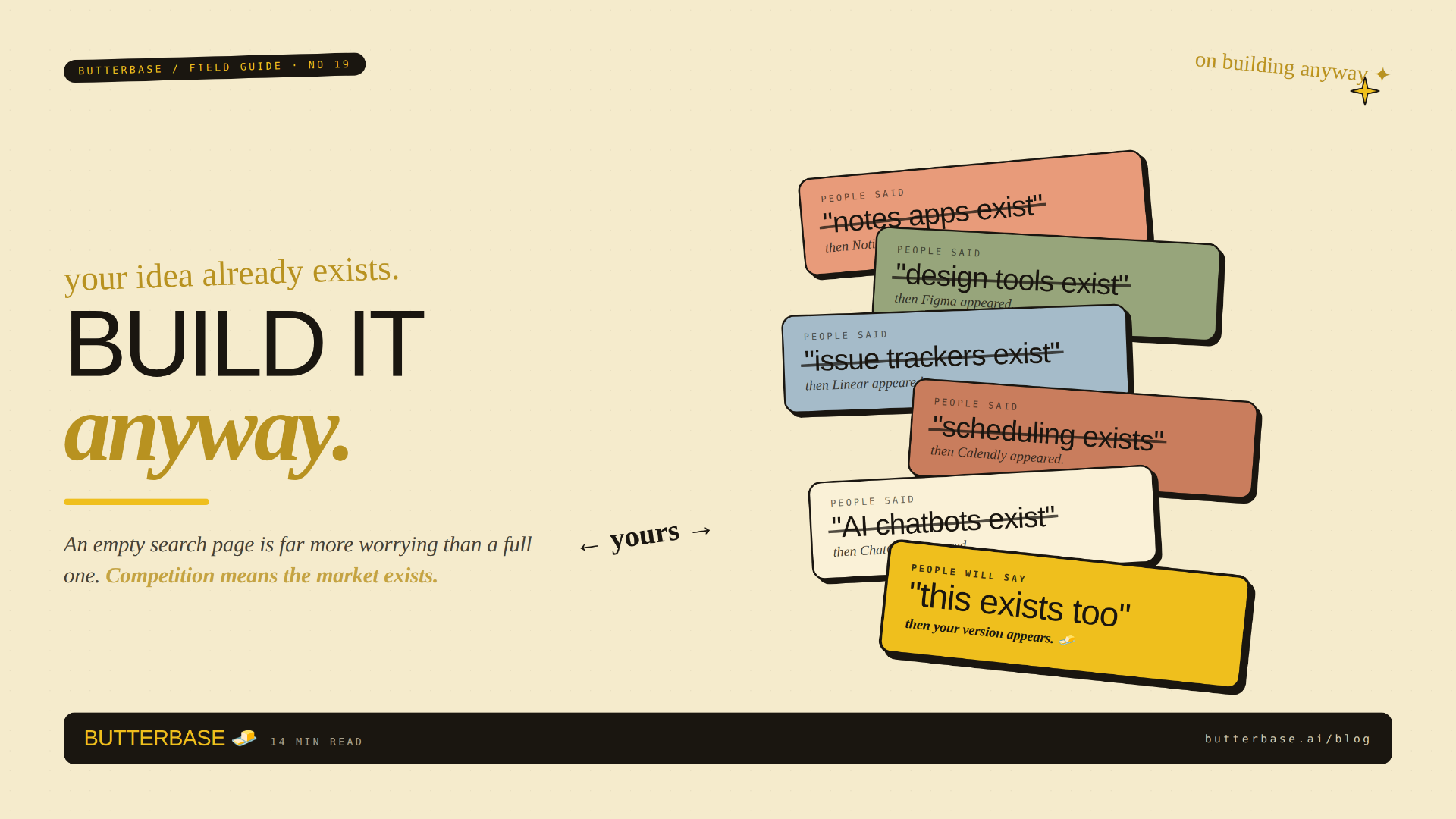
You had the idea. You were excited about it. Then you opened a browser and typed it into Google.
There it was. Three competitors. Five ProductHunt listings. A Reddit thread from two years ago asking if anyone had built exactly this thing - with twelve replies linking to tools that do. Maybe there is even a well-funded startup with a polished landing page doing precisely what you were thinking.
And just like that, the excitement deflates. You close the tabs. You tell yourself you will think of something more original.
This is the moment that kills more ideas than any technical problem, funding gap, or difficult market. It is the false signal that "already exists" means "no point building." It is wrong. And the reason it is wrong is not optimistic hand-waving about differentiation - it is more fundamental than that.
This article is for anyone who has felt that deflation. We will work through exactly when existing competition is a real problem, when it is not, and the specific situations where building something that already exists is actually the right move.
The short answer
Competition means a market exists. An empty search results page is far more worrying than a full one. The question is never "does this exist?" The question is "does the version I need exist?" - and usually, it does not.
Why "it already exists" is almost always the wrong reason to stop
Think about the last five products you paid for or used regularly. How many of them were the first product of their type?
Your notes app was not the first notes app. Your email client was not the first email client. Your task manager was not the first task manager. Notion was not the first wiki. Linear was not the first issue tracker. Figma was not the first design tool. Every single one of them entered a market where competitors already existed - often dominated by a well-funded incumbent - and found enough users to become a real business anyway.
The reason is simple: markets are not winner-take-all for most products. The world is large, people have different needs, and "the same thing" is never actually the same thing. Notion and Obsidian both let you write notes. They serve almost completely different people, because the philosophy behind each product is fundamentally different, and philosophy determines whether a tool feels right. Calendly and Cal.com both handle appointment scheduling. Cal.com exists because a meaningful number of people wanted something open-source that they could self-host and modify, which Calendly would never become.
The question "should I build this?" is almost never determined by whether it exists. It is determined by whether your specific version of it can reach enough people who find it more valuable than what is already there.
The three situations where existing competition is genuinely a problem
There are situations where an existing product really does make your idea harder to build. It is worth being honest about them.
The market is locked in by switching costs. Some products become valuable because the people who already use them cannot leave. A payroll system, for example. When a company's employees are already paid through a platform, every HR team is enrolled, every accountant is trained on it, and historical records are stored there, switching is genuinely painful. Building a better payroll platform does not mean companies will switch - the switching cost is too high. If the existing product has this kind of lock-in, competition is a real obstacle.
The market requires network effects to function. A social network without users is useless. A marketplace without buyers and sellers has nothing to buy or sell. A communication platform where none of your colleagues are is worthless. If the product only has value when the people you need to use it already use it, breaking in as a new entrant is extremely hard. This is not impossible - Discord entered a market with TeamSpeak and Mumble and won - but it requires a very specific audience or community angle to work.
A well-resourced incumbent can copy and crush you. If you are building a feature that a platform like Salesforce, Google, or Apple could ship as a small update to an existing product, and that feature is the entire point of your product, that is a structural problem. The "getting acquired" version of this is fine; the "copied and ignored" version is not.
For the vast majority of vibe-coded products - booking systems, internal tools, niche SaaS, community platforms, workflow automation - none of these apply. The market is not locked. There are no meaningful network effects. And you are not in the crosshairs of a trillion-dollar company.
The four situations where existing competition is actually good news
It means the problem is real. A market with competitors is a market where someone has already validated that people will pay money to solve this problem. If you are building a booking system for equestrian instructors and there are three competitors doing it for a broader fitness audience, that is evidence that people in the general problem space pay for solutions. You are not guessing at demand. The demand exists. You are just choosing your slice of it.
It tells you what the customer already knows. When a product already exists, the people you want to reach already understand why they need a solution. You do not have to explain the category. You do not have to create the market. The incumbent already spent money educating potential customers, and you inherit the benefit of that. Every person who has tried Calendly and found it too expensive, too generic, or not quite right for their specific situation is a warm lead for a better-fitting alternative.
It gives you a roadmap of exactly what not to build. Review a competitor's negative reviews on G2, Capterra, or the App Store and you will find a detailed product brief for what is missing. The complaints are specific. "The calendar doesn't sync correctly." "It doesn't support recurring bookings." "The client portal is too confusing." "We needed team scheduling and it's all individual." Every complaint is a feature. The competitor already built the version that almost works. You get to build the version that does.
It creates the opportunity to be the one for a specific person. Almost every large SaaS starts as a generic solution that serves everyone adequately and no one perfectly. The gap it leaves is always in specificity. If your competitor serves 50 different industries, it has necessarily built a product that makes no single industry feel at home. A tool built specifically for dog groomers will beat a generic booking tool for dog groomers every time - not because it has more features, but because every choice it makes reflects the reality of running a dog grooming business. The generic tool can never do that, because if it did, it would stop being generic.
The real question to ask about a competitor
Not "does this exist?" but "does this exist for me, the way I actually need it?"
Run through this quickly for any competitor you find:
Is it built for my specific situation or for a much broader audience? A booking tool for personal trainers might exist, but is it built for personal trainers who also sell digital programs, need group class management, and work out of multiple locations? Probably not. Specificity is always available as a position.
Do the people I would build this for actually know it exists? Discovery is half the battle. If the existing solution is hard to find, not marketed to your audience, or buried under enterprise pricing and features, it might as well not exist for the people you would reach.
Is the pricing appropriate for the people I would build this for? Enterprise SaaS pricing - $50 per user per month minimum, annual contract required - effectively does not exist for most small businesses. A version of the same product at $19 per month aimed at sole traders is, practically speaking, a different market.
Is it actually good? A surprising number of incumbents persist not because they are good but because they got there first and switching costs are real. If the existing product is confusing, slow, badly supported, or not actively maintained, there is room.
If you can answer "no" to any of those questions, the product you are thinking of building is genuinely different from what exists - even if it sounds the same when you describe it in a sentence.
The case for building something just for you
There is a version of this question that does not require any of the above reasoning: building something that already exists because you need it and the existing version is not right for you.
Obsidian exists, and people still build their own note-taking systems, because the system that works for how your brain works does not exist yet. Notion exists, and developers still build personal wikis, because Notion is too many things and the version that is exactly right for a particular workflow has not been built yet.
When you build something for yourself, you are not trying to capture a market. You are solving your own problem. If a hundred people exactly like you find it later, that is a bonus. If you use it yourself every day, the project was worth building.
This is where vibe coding changes the calculus significantly. Before 2026, building a custom internal tool, a personal app, or a niche product was expensive. It took weeks of development time or thousands of dollars paid to someone else. The cost-benefit calculation often did not work out.
Now it is an afternoon. With an agent-native backend like Butterbase, you describe what you need in plain English and the schema, auth, storage and APIs are provisioned behind the scenes while you stay in the same chat. The economics are completely different. You do not need to capture 10,000 customers to justify the investment. You need to solve a problem that is worth a few hours of your time. The existence of a competitor is almost irrelevant when the build cost is that low.
When to stop anyway
There are two real reasons to not build something, and neither of them is "it already exists."
You do not actually have the problem. If you are building something for a user whose pain you do not understand firsthand, and you are not willing to talk to a lot of those users before and during building, the chance of building the wrong thing is very high. This is a reason to validate the idea first, not a reason to abandon it. But it is a real risk.
You are not willing to do the distribution. Building is the easy part now. The hard part is getting the right people to know about what you built. If there is no clear answer to "how will the first hundred people find this," the product being built will not reach them regardless of how good it is. This does not mean you need a marketing agency - it means you need to know one channel. One community. One audience you can reach directly.
Neither of these is about competition. They are about you and your specific project.
What this means for what to build next
If you have an idea, the presence of competitors should change how you build, not whether you build.
It should push you toward specificity. The broader the existing competitors, the more opportunity there is to serve a specific sub-audience extremely well. Resist the instinct to build the generic version of the thing. Build the version for equestrian instructors, for solo consultants, for independent coffee shops, for whichever specific person this actually needs to exist for.
It should push you to start with the problem, not the feature list. The competitor has already built a feature list. What you can beat is the experience - the feeling of using something built for exactly your situation rather than adapted to it. That experience is what earns loyalty, referrals, and retention. It cannot be captured in a features comparison table.
It should tell you to launch small and specific. The goal is not to capture the entire market on day one. The goal is to have ten users for whom this is the best solution they have ever found. Ten users who feel that way will tell ten more. The generic competitor with a thousand indifferent users is actually in a worse position than you are.
The product you are thinking of building probably does exist in some form. That is fine. The version of it that is exactly right for the person you have in mind almost certainly does not. That is where you build.
Frequently asked questions
Money accelerates execution, but it does not guarantee product-market fit for every sub-audience. Well-funded startups optimise for their largest customer segments and leave smaller or more specific needs underserved almost by design. If you can reach an audience that the funded competitor ignores, the funding advantage largely disappears. Most early-stage competitors lose to focused execution for specific users, not to each other on features.
Giants make terrible products for specific users because specificity costs them the scale they need. Google Calendar is designed for everyone, which means it is designed for no one in particular. If you are building a scheduling tool for a specific workflow - say, therapists managing insurance verification alongside appointment booking - Google Calendar will never build that. The size of the competitor is actually an advantage here, because the bigger they are, the less they can afford to care about your audience.
Yes, if you can find them. Five conversations with people who currently use a competitor - about what they like, what frustrates them, and what they wish existed - will save you more time than any amount of research. The most useful interviews are with users who recently switched away from a competitor (they have clear reasons) and users who tried a competitor and did not adopt it (they have specific unmet needs).
If you can complete the sentence "this is for [specific person] who [specific situation], unlike [competitor] which is built for [broader audience]" - you have something that is genuinely different in a meaningful way. If you cannot fill in the brackets specifically, you may be building the same thing. The test is whether someone who fits your description would choose yours over the competitor without being asked to.
If a bigger competitor copies you, it is a signal that you were right about the market. The companies that get copied most are the ones serving an audience the incumbent ignored until it became undeniable. At that point, you have a head start, a community, and the reputation of having been first for your people. Incumbents who copy rather than acquire often do it badly, because the specificity that makes the original work is the thing they are least equipped to replicate.